I am disturbed by the recent news that 300,000 Black women have left the labor force within a three-month period, largely due to dramatic cuts to the federal workforce. For too long now, when we are confronted by actions and situations that look, taste, and smell like discrimination, we have been stuck in a moral accountability universe where intentions reign and outcomes matter not. Each elbow to the rib is covered over by a “I didn’t see you there,” and the veil grows thinner and thinner in a social environment that is seemingly too exhausted to pursue universalized justice.
This targeted yet somewhat deniable act of intersectional discrimination against Black women has occurred against the backdrop of an expanding racial wealth gap and an occupational structure where Black women and men continue to be undervalued. It is clear that what has evolved into another era of ‘great white panic’ cannot be explained by any Black material gains, since the data is showing more bad news than good news on that front.
The accumulating evidence suggests the root of the current panic is a concerted attempt to preserve a culture of white patriarchal dominance in the face of a racial demography where there will be no single-race majority and the prospects of a cultural universe that aspires beyond the prevailing images of respectable identities, families, and lifestyles. The visible attempts to interrupt more colorful futures are essentially anti-rational and inhumane. A central thread of these attempts is the promotion of sentiments and postures that are antagonistic towards the facts of history and the disruption of reparative orientations to building relationships across the demarcations of race, gender identity, and class.
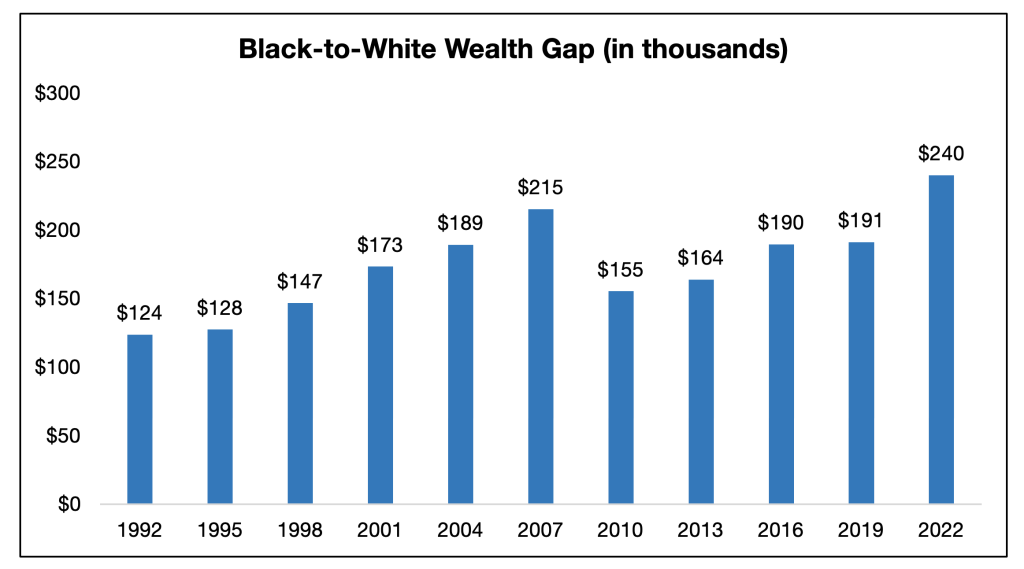
Still, despite the antagonistic energy towards fact-finding and fact-reporting efforts, the truth must be told. And one of these truths is an expanding racial wealth gap in the midst of white panics that have targeted initiatives designed to support the long-neglected. The findings from the past three Survey of Consumer Finances reports revealed that the racial wealth gap has continually expanded. In fact, this specific time period reflects three of the largest Black-to-White wealth gaps since 1992, with 2022 showing the largest gap on record for this 30-year period. Specifically, the data shows the median White household had access to nearly $240,000 more in wealth than the median Black household (see the table below). Such a fact, coupled with the ongoing trend in the wealth gap data, makes it difficult to take certain arguments seriously. But what will the 2025 numbers show?
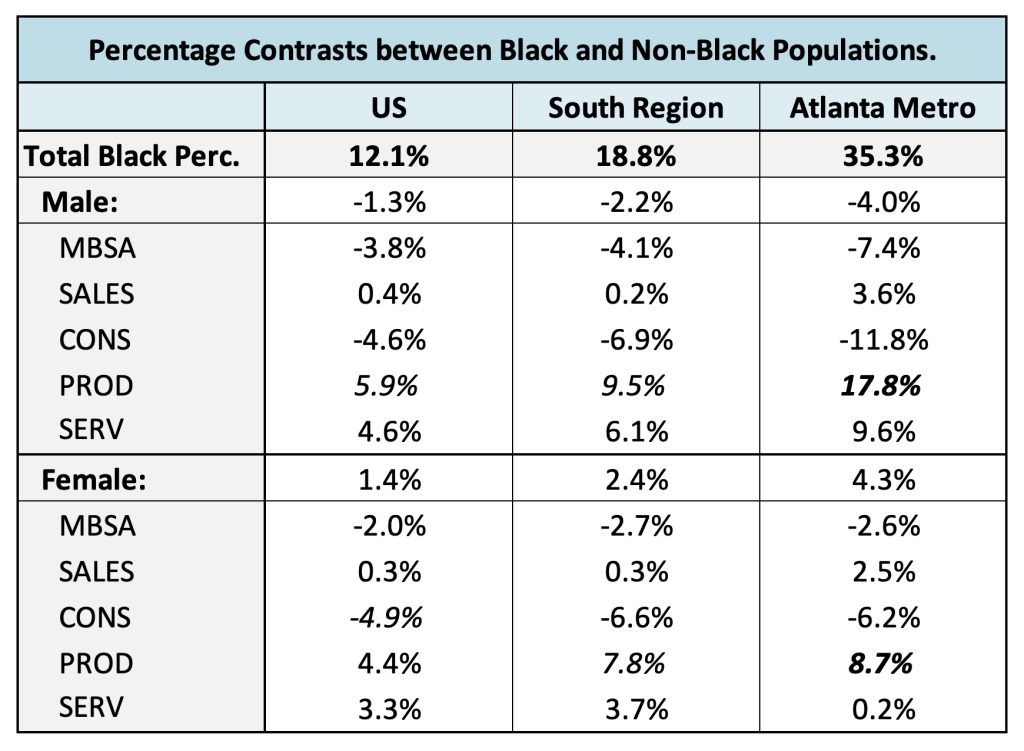
Another truth is Black women and Black men continuing to be undervalued in the occupational structure, regardless of whether these economic relations are structured at the national, regional, or urban levels. The table below shows that Black men and Black women are underrepresented in MBSA positions across the board. Among occupational categories, MBSA jobs are the highest paying. Scholars and practitioners commonly associate the MBSA category with middle-class jobs. At the same time, both Black women and men are overrepresented in production (PROD) and service (SERV) jobs, the two lowest-paying occupational categories.
In a more rational world, our aims and motivations would be centered on social facts, not whims, vibes, and unjustifiable fears. The numerical facts of the expanding racial wealth gap and the undervaluing of Black Americans in the civilian workforce are instructive. However, these numbers are not sufficient stand-ins for the individuals and families who continue to work, struggle, and strive in environments that are coded to devalue their contributions, depth of character, and their histories. Surely, the struggle continues to right a future that is rational, forward-moving, and embracing of humanity in all its flavors and colors.