The seedbed of community prosperity is a collection of households feeling a sense of stability in homes that they find to be safe, decent, and affordable. With this basic need established, along with food, clothing, and transportation, individuals and families can go forth and pursue their version of a prosperous life and start to build community-level relationships. Communities that seize the opportunities that are latent in unleashing their relational resources can translate these resources into a collective power that either uplifts their neighborhoods to new heights or preserves the prosperity they have already cultivated together.
The recorded history shows that in the US the achievement of community prosperity has been racially defined, gated, and resisted. The scholarship documenting this social pattern is robust, ranging from works such as The Crabgrass Frontier to more recent works such as The Color of Law. The social and political forces that naturalize neighborhood patterns that are morally troublesome for people of good conscience are not easy to overcome, but we must try, if only to appease that higher version of ourselves that knows we can and must advance to a higher plane of existence.
One of the clearest indicators that we are currently living in a social reality deeply shaped by historical racism is the racial makeup of our neighborhoods. Regardless of all the rhetoric, our neighborhoods speak louder on the subject of who we value and what we prefer in our close-to-home spaces. The racial makeup of neighborhoods is unfortunately a powerful predictor of all sorts of our social and economic outcomes such as the rate of neighborhood poverty and the market value of houses. A common lament that I’ve heard with my own ears is the price difference between houses with the same build and features on the Black side of town versus the White side of town.
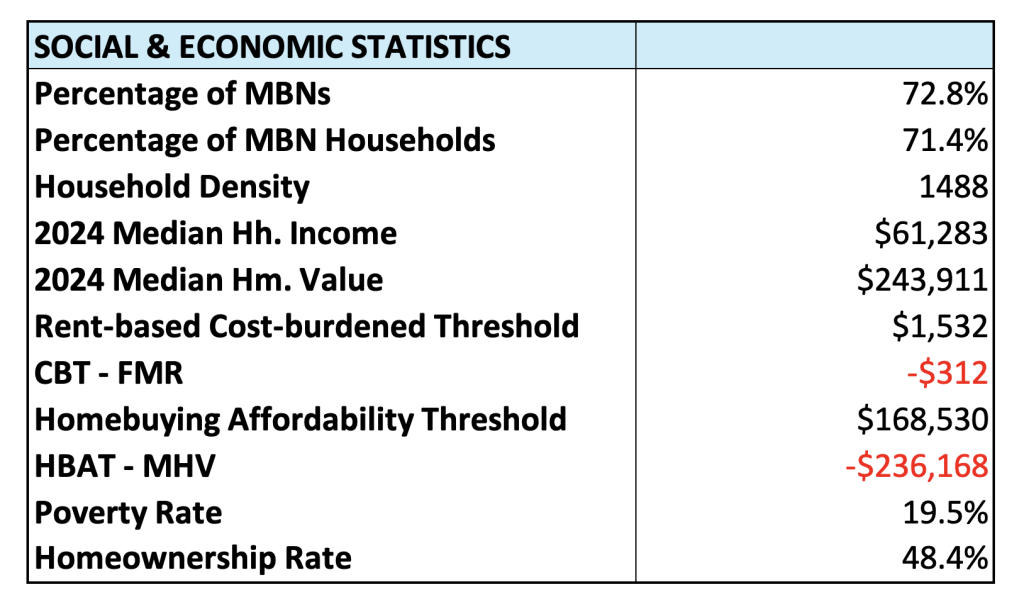
The same pattern holds even for a place as unique as Metro Atlanta. My analysis shows that 72.8 percent of majority-Black neighborhoods in the Atlanta Metropolitan Statistical Area (MSA) are disadvantaged when compared to MSA-level neighborhood metrics (see table below). These neighborhoods house 71.4 percent of the households living in majority-Black neighborhoods. On average, the median household income (MHI) for these neighborhoods is $61,283, which is approximately $30,000 below the MSA MHI. This income level translates to cost-burdened threshold of $1,532 with respect to rental affordability. This amount is $312 below the Fair Market Rent (2024 data) for the metro area. This income also translates to a homebuying affordability threshold of $168,530, which is approximately $230,000 below the median home value for the MSA. One of the bright spots for these neighborhoods is that their average poverty rate is just below the common standard used to identify poor neighborhoods (20-percent threshold).
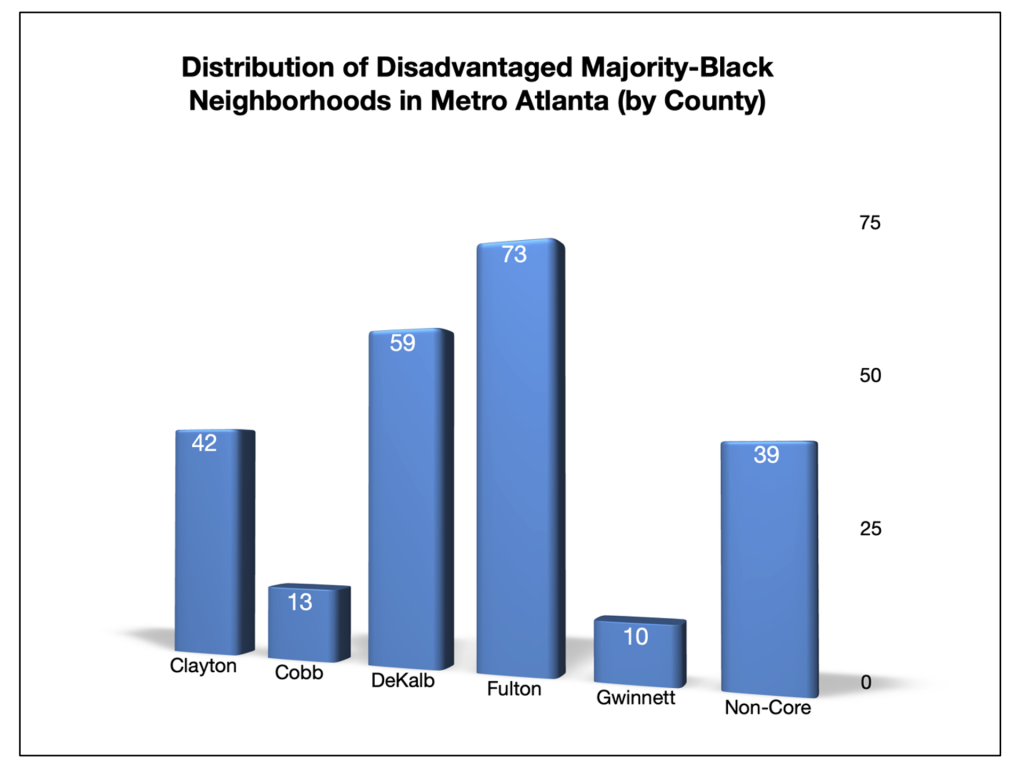
The county-level perspective reveals that the vast majority of these disadvantaged neighborhoods are found in Metro Atlanta’s core counties of Clayton, Cobb, DeKalb, Fulton, and Gwinnett. The graph below shows that Fulton County is the setting for the highest number of disadvantaged neighborhoods, while DeKalb and Clayton counties alone have more disadvantaged neighborhoods than the number found for all of the non-core counties within the Atlanta MSA. Cobb and Gwinnett counties have the fewest disadvantaged majority-Black neighborhoods (MBN).
These neighborhood realities represent the work ahead for all of us who cherish community prosperity regardless of the racial makeup of neighborhoods. The fact that 7 out of 10 MBN households in Metro Atlanta live in neighborhoods where residents cannot afford market-rate rent is unsettling. These numbers strongly indicate that more robust support for these neighborhoods is critically needed and that this support will need to be multi-pronged.
Gaining a clear, robust, and detailed understanding of neighborhood and metro area realities is one of the cornerstones of advancing community prosperity. I look forward to expanding and deepening connections with organizations, leaders, and collaborators who value fresh approaches for translating data and insights into community-focused forward advancement.