This second-to-last installment in the “Revealing Majority-Black Neighborhoods in Metro Atlanta” series is dedicated to fully advantaged majority-Black neighborhoods. As neighborhoods that better the Atlanta Metropolitan Statistical Area (MSA) statistics on every measure, they stand in direct contrast to the public image of Black neighborhoods. Unfortunately, my analysis only identified two such neighborhoods.
As 2 neighborhoods out of the 324 majority-Black neighborhoods in Metro Atlanta, their level of representation was only 0.6 percent. The percentage of MBN households living in fully advantaged neighborhoods was 0.8 percent. Following the same pattern of every neighborhood type except for disadvantaged neighborhoods, my analysis revealed a surplus number of households vis-à-vis the number of neighborhoods.
The median household income (MHI) for fully advantaged neighborhoods was $111,476, which is approximately $20,000 above the MSA MHI, yet more than $1,000 below the MHI for mostly advantaged neighborhoods (see table below). This income level translates to a rental cost-burdened threshold of $2,787, which leaves households with $943 in residual income when applied against the Fair Market Rent (2024 data) for the metro. When it comes to homebuying, this income translates to an affordability threshold of $306,559 which is about $98,000 below the MSA-wide median home value.
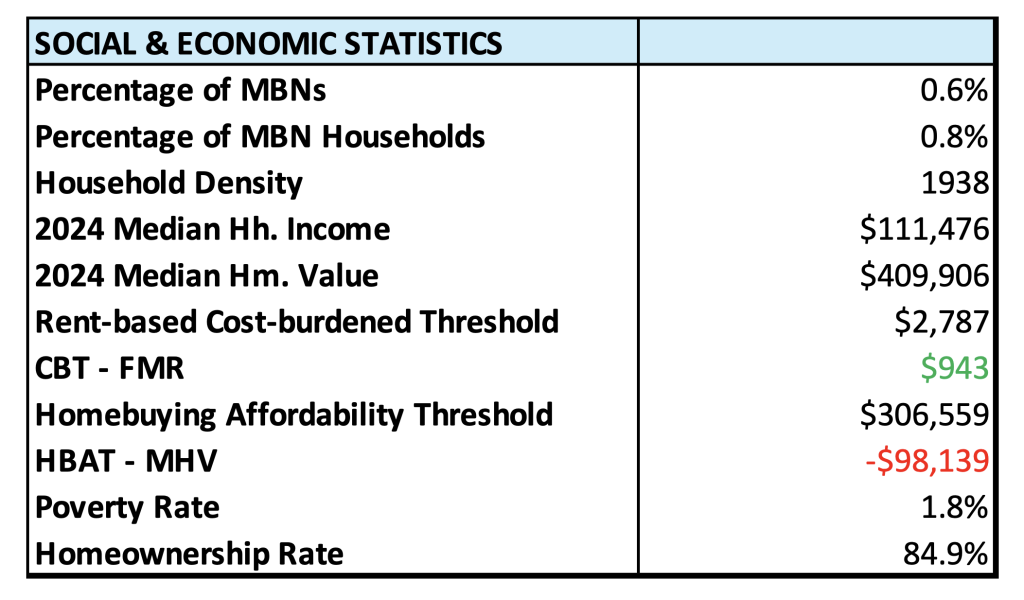
Despite having a lower average MHI than mostly advantaged neighborhoods, the fully advantaged nature of these neighborhoods is certified based on their superior median home values (MHV). The distance between the MHVs of these neighborhood types overshadows the distance between MHIs. This effectively means that Black households earning very similar incomes live in neighborhoods that are projected to yield impactfully different intergenerational wealth outcomes. Such differences in intergenerational wealth outcomes is a reality that shows why the fewness of fully advantaged MBNs is problematic and likely explains why higher income Black households choose to live in neighborhoods outside of the MBN category.
Both of the fully advantaged MBNs are outside of Metro Atlanta’s core counties. One is in Rockdale County, bordering DeKalb County and the other is in Henry County, which borders Clayton County. Geographically, both neighborhoods are southeast of Atlanta. This dynamic concretizes the pattern of a higher concentration of economically advantaged MBNs in non-core counties and a higher concentration of economically disadvantaged MBNs in the core counties. Digging into the ‘whys’ behind this pattern could be a fascinating line of inquiry.